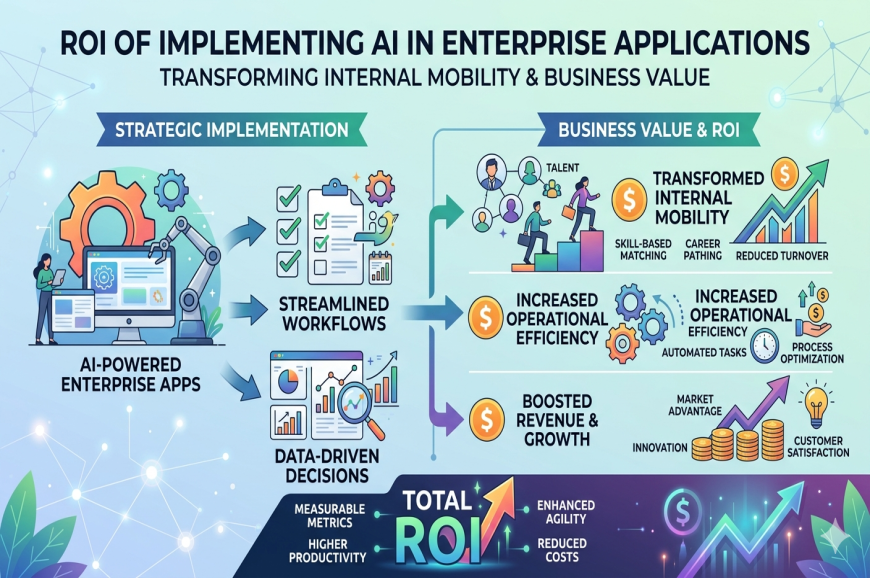
Introduction: Why ROI of AI Matters More Than Ever
Artificial Intelligence is no longer an experimental investment. It has become a strategic necessity for enterprises seeking growth, resilience, and operational efficiency. However, for C-suite leaders, one question dominates every discussion:
What is the real ROI of AI?
Understanding the ROI of AI in Enterprise Applications goes beyond cost savings. It includes workforce transformation, decision intelligence, and competitive advantage.
More importantly, AI is reshaping one of the most overlooked yet high-impact areas of business performance: internal mobility.
Organizations that leverage AI to move talent internally are not only reducing hiring costs but also unlocking hidden productivity and engagement.
TL;DR
AI is driving measurable ROI through automation, smarter decisions, and workforce optimization
Internal mobility powered by AI reduces hiring costs and boosts retention
Enterprises achieve 20–40% efficiency gains with AI-enabled workflows
The ROI of AI in enterprise applications depends on strategic implementation, not just technology
HRMS platforms like AppWorks enable AI-driven talent insights and workforce agility
AI improves employee experience, productivity, and long-term business value
Understanding the ROI of AI in Enterprise Applications
What Does ROI Really Mean in AI?
The ROI of AI in Enterprise Applications is a combination of:
Cost reduction (automation, efficiency)
Revenue growth (better decisions, faster execution)
Risk mitigation (predictive analytics)
Workforce optimization (internal mobility, retention)
Unlike traditional software ROI, AI ROI compounds over time. The more data AI processes, the smarter it becomes.
Key Components of AI ROI
Operational Efficiency Gains
Reduced Manual Workloads
Improved Decision Accuracy
Enhanced Employee Productivity
Talent Retention and Internal Mobility
When implemented correctly, AI delivers both tangible and intangible returns, making it a long-term strategic asset.
How Is AI Revolutionizing Internal Mobility in Modern Workplaces?
The Shift from External Hiring to Internal Talent Optimization
Traditionally, enterprises relied heavily on external hiring. This approach is expensive, time-consuming, and often inefficient.
AI changes this paradigm by:
Identifying internal talent gaps
Matching employees to new roles
Predicting career paths
Enabling reskilling opportunities
This is where the ROI of AI in Enterprise Applications becomes clearly visible.
AI-Powered Internal Mobility: Key Capabilities
1. Skill Mapping & Talent Intelligence
AI analyzes employee skills, experience, and performance data to build dynamic talent profiles.
2. Predictive Career Pathing
AI suggests career growth opportunities, increasing employee engagement and retention.
3. Automated Role Matching
Instead of manual HR processes, AI instantly matches employees to open roles.
4. Learning & Development Recommendations
AI recommends personalized training programs aligned with business goals.
Why Internal Mobility Drives High ROI
Internal mobility is one of the fastest ways to unlock AI business value and cost savings.
Key ROI Drivers
1. Reduced Hiring Costs
External hiring is 2–3x more expensive than internal mobility
AI minimizes recruitment expenses
2. Faster Time-to-Fill Roles
AI reduces hiring cycles from months to weeks or days
3. Improved Retention
Employees are more likely to stay when growth opportunities exist
4. Higher Productivity
Internal hires ramp up faster than external candidates
This directly strengthens the ROI of AI in Enterprise Applications.
Benefits of AI in Enterprise Software
The Benefits of AI in enterprise software extend far beyond HR functions.
1. Intelligent Automation
AI automates repetitive tasks, freeing up human capital for strategic work.
2. Data-Driven Decision Making
Executives gain real-time insights for faster and better decisions.
3. Enhanced Employee Experience
AI personalizes employee journeys, improving satisfaction and engagement.
4. Scalability
AI systems grow with the business, adapting to new challenges.
5. Risk Reduction
Predictive analytics helps identify risks before they escalate.
All these benefits contribute to maximizing the ROI of AI in Enterprise Applications.
AI Implementation Cost vs ROI: What Leaders Need to Know
One of the biggest concerns for executives is the balance between “AI implementation cost vs ROI”.
Understanding AI Costs
AI implementation typically includes:
Software licensing
Infrastructure (cloud, data storage)
Integration with existing systems
Training and change management
Where ROI Outweighs Costs
Despite upfront costs, AI delivers:
Long-term cost savings
Reduced operational inefficiencies
Increased workforce productivity
Better utilization of existing resources
Key Insight for C-Suite Leaders
The real question is not:
“Can we afford AI?”
But rather:
“Can we afford NOT to implement AI?”
Because competitors already are.
Enterprise AI Use Cases and ROI
Let’s explore real-world Enterprise AI use cases and ROI across functions.
1. HR & Talent Management
AI-driven recruitment
Internal mobility platforms
Workforce analytics
ROI Impact:
Reduced hiring costs by up to 30%
Improved retention rates
2. Finance & Operations
Fraud detection
Automated reporting
Forecasting
ROI Impact:
Faster financial close cycles
Reduced risk exposure
3. Customer Experience
AI chatbots
Personalized recommendations
ROI Impact:
Higher customer satisfaction
Increased conversion rates
4. Supply Chain Optimization
Demand forecasting
Inventory management
ROI Impact:
Reduced waste
Improved delivery efficiency
These use cases reinforce the ROI of AI in Enterprise Applications across departments.
How AI Enhances Workforce Productivity
From Reactive to Predictive Workforce Management
AI transforms HR from administrative to strategic.
Key Transformations:
Predict workforce needs
Identify skill gaps early
Optimize team structures
AI + HRMS: A Powerful Combination
Modern HRMS platforms like AppWorks Technologies enable:
Real-time workforce analytics
AI-driven performance insights
Automated employee lifecycle management
This allows leaders to make smarter workforce decisions while maximizing the ROI of AI in Enterprise Applications.
Measuring ROI of AI in Enterprise Applications
Key Metrics to Track
To evaluate success, track:
Cost per hire
Employee retention rate
Time-to-productivity
Operational efficiency
Employee engagement scores
Quantitative vs Qualitative ROI
Quantitative:
Cost savings
Revenue growth
Qualitative:
Employee satisfaction
Innovation capability
Organizational agility
Both are essential to understanding the full ROI of AI in Enterprise Applications.
Challenges in AI Adoption (and How to Overcome Them)
1. Data Silos
Solution: Centralized data systems
2. Change Resistance
Solution: Leadership-driven transformation
3. Skill Gaps
Solution: Upskilling and AI training programs
4. Integration Issues
Solution: Scalable, flexible platforms
A structured approach ensures higher ROI and smoother adoption.
The Strategic Role of HRMS in AI-Driven Enterprises
HRMS platforms are no longer just administrative tools.
They are now strategic enablers of AI transformation.
How AppWorks Technologies Adds Value
Without being overly promotional, here’s how platforms like AppWorks contribute:
Centralized employee data for AI insights
Seamless integration with enterprise systems
Automation of HR workflows
Real-time analytics for decision-making
Internal mobility enablement
This creates a strong foundation for achieving a higher ROI of AI in Enterprise Applications.
Future of AI in Enterprise Applications
What Lies Ahead?
Hyper-personalized employee experiences
Fully autonomous workflows
AI-driven organizational design
Continuous learning ecosystems
The Competitive Advantage
Organizations that invest early in AI will:
Attract top talent
Retain employees longer
Operate more efficiently
Innovate faster
This makes the ROI of AI in Enterprise Applications not just measurable—but transformative.
Conclusion
AI is not just a technology upgrade. It is a business transformation strategy.
For C-suite leaders, the focus should shift from:
“Should we invest in AI?”
to
“How do we maximize the ROI of AI?”
By leveraging AI for internal mobility, workforce optimization, and decision intelligence, enterprises can unlock unprecedented value.
The ROI of AI in Enterprise Applications is no longer theoretical—it is proven, measurable, and essential for future growth.
If you’re looking to unlock the true ROI of AI in enterprise applications and transform how your workforce operates:
Start by rethinking your HR and workforce strategy.
AppWorks Technologies helps enterprises implement AI-driven HRMS solutions that:
Enhance internal mobility
Improve workforce visibility
Reduce operational costs
Drive measurable business outcomes
Book a consultation with AppWorks Technologies today and explore how AI can deliver real ROI for your enterprise.